
Titanium vs Tungsten: A Designer’s Guide to CNC Machining for High-Performance Applications

Introduction
In performance-driven fields such as architectural facades, healthcare instruments, or aero parts, designers are faced with a crucial decision regarding which material to choose. Though there are many positive aspects of both the weight-saving qualities of titanium and the high strength of tungsten materials, improper selection can be a cause of cost escalations and rework. In conventional material selection approaches, a single criterion such as strength or density is taken into consideration. Additionally, manufacturability and adaptability to environmental conditions can be ignored.
The following guide aims to offer a systematic approach to decision-making for materials, marrying knowledge of CNC machining and facts to offer a balanced view of performance and the realities of machining. The next sections will examine key performance variables, machining limitations, and the economics for making scientifically informed decisions.
What are the basic properties of the materials titanium and tungsten?
The principal properties of titanium and tungsten play an important role at the very beginning of decision-making in any high-stake project. Material characteristics drive design flexibility, manufacturing processes, and end-use performance. We explore below three core aspects that define these metals.
1. Density and Weight Implications for Design Applications
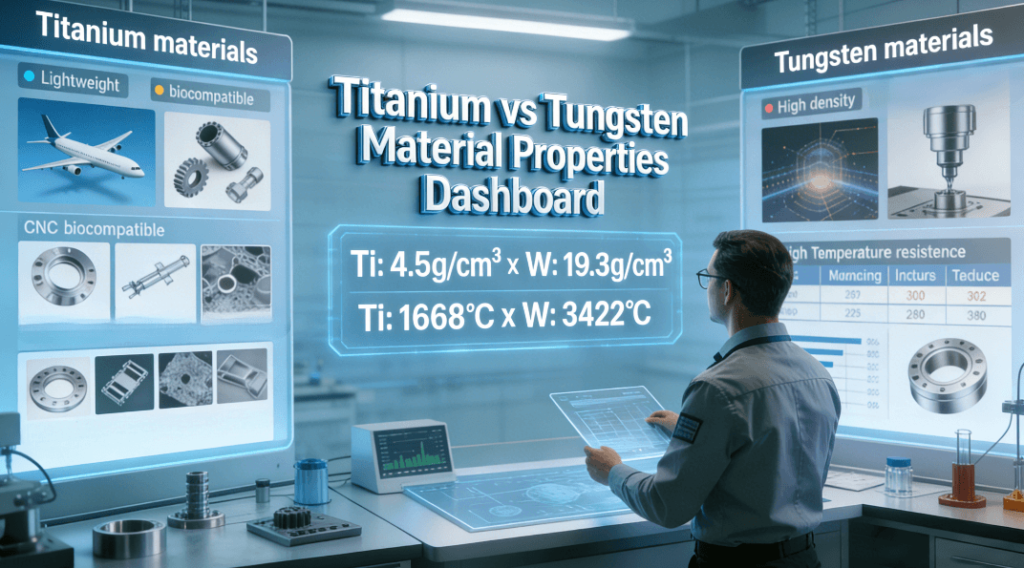
Thus far, titanium has been shown to be relatively dense with its value at around 4.5 g/cm³, whereas tungsten is much denser at around 19.3 g/cm³. This large difference is important in considering weight factors that may be applicable in aviation or portable medical equipment. Weight lowered in aviation applications may show great fuel savings since less fuel is required to power heavier objects to desired velocities and altitudes. On the contrary, tungsten is suited for those applications that require high mass concentration in as small of volume as possible, such as weight counters or radiation blocks.
2. Melting Point and Thermal Stability Under Extreme Conditions
The melting point of titanium is in excess of 1,668°C, while that of tungsten is in excess of 3,422°C. The property of withstanding higher temperatures makes it ideal for use in rocket components at very high temperatures. On the flipside, it has a rather low melting point compared to other metals, and its use in CNC machines is not as challenging as it would be to work with metals with properties that make them stand in opposition to heat in its natural behavior on Earth. The engineer considers temperatures of use when employing these materials to prevent failure.
3. Hardness, Strength, and Corrosion Resistance
Hardness value for Titanium is typically in the range of 150-200 HV, with high corrosion resistance properties due to its oxide layer. According to ASTM B117 Salt spray test, Corrosion resistance properties along with long service life in corrosive environment make Titanium a major contender for any work that has a connection with the ocean or chemical process industry. The high hardness value for Tungsten varies between 300-500 HV, which is highly resistant to wear but is more brittle compared to Titanium and less corrosion-resistant. For any application with a long life requirement for protection from corrosion or abrasion, one must understand both the corrosion protection film properties of Titanium and the high hardness value of Tungsten. High-end CNC Machining facilities can utilize all these properties to their advantage.
In What Ways Does Machinability Affect Design Flexibility for Various Materials?
Machinability stands out as an important point that impacts the possibility of having the geometrical complexity with high precision. CNC machining services for titanium and tungsten is an entirely different process, and the challenges associated with machinability are divided into three crucial areas in this section.
1. Tool Selection and Wear Management Strategies
Titanium tends to stick to the cutting tools, so there is a tendency for the development of built-up edges and rapid tool wear. Tungsten machining requires the application of polycrystalline diamond tools and lower cutting velocities due to its hardness. As a designer, one has to consider tooling expenses as part of project planning because tooling cost and maintenance cycle play an important role. Establishing an effective tool management program, consistent with ISO 9001 standards for quality, results in consistent performance with minimum downtime for high volume productions.
2. Geometric Complexity and Design Compromises
The machinability of titanium makes it easier to produce complex geometries, like small details, thin-walled structures, or deep cavities, due to the material’s moderate hardness level. This characteristic also recommends titanium for demanding applications involving complex biologically inspired shapes, for the production of complex implants, for instance. In contrast, the brittleness of the material poses a constraint on the production of small details without fracture for applications involving simpler, highly worn-out products, for instance, molds or cutting inserts. The use of advanced CAD/CAM systems helps to optimize the machining of all the three materials.
3. Cooling and Process Control for Optimum Achievements
Machining titanium requires effective thermal management to avoid work hardening and inaccuracy of dimensions. The use of high-pressure coolant systems directed into the cutting zone maintains tool integrity and surface finish. For tungsten, it requires controlled machining speeds and feeds to avoid thermal shock and microfractures. Adherence to ISO 9001 guidelines on process control ensures that the machining parameters are constantly monitored and adjusted. The degree of precision so achieved by designers allows for small tolerances-some applications may have small tolerances, like precision engineering applications-and minimizes scrap rates.
What Is the Cost Driver in the Titanium vs. Tungsten CNC Projects?
Cost considerations extend beyond initial material price to include machining efficiency, tooling and lifecycle costs. A detailed cost-benefit analysis can be used to justify the choice of a material based on total cost of ownership. Here, we look at three key cost drivers.
- Raw Material Prices and Supply Chain Issues: The cost of tungsten metal is comparatively high compared to titanium in a kilogram due to its relative abundance and complicated extraction process. However, these costs can vary depending upon some fluctuating factors in the total market demand and other requirements related to pureness for purchase. For example, titanium metal with high strength and used in the aviation field has high material costs; its lighter material properties could potentially work as fuel-neutralizing agents in aviation applications. Engineers should procure these metal materials from trusted suppliers to stay away from material uncertainties.
- Tooling, Energy Consumption, and Waste Management: High hardness in tungsten results in rapid tool consumption, thus high tooling costs. Titanium, being less hard on tools, is laborious to machine because of low thermal conductivity. Secondly, both materials pose challenges in terms of scrap materials for disposal or recycling. To counter the challenges, effective coolant systems should be implemented. For instance, in mass production, although the high hardness in tungsten results in high tooling costs, a longer lifespan for the product will make it feasible for use in an industrial mold.
- Lifecycle Cost Analysis and Return on Investment: A lifecycle cost analysis should consider costs of maintenance, replacement, and benefits of operation. Corrosion resistance of titanium results in lower maintenance costs for operation in extreme environments, and wear resistance offered by tungsten increases the lifespan of the components used in abrasion applications. Case studies have indicated that for aerospace applications, fuel savings are achieved because of the weight reduction offered by titanium, and for manufacturing applications, changeovers are decreased because of the tungsten tools. There is a need for designers to calculate the TCO, rather than merely bearing the costs of materials.
How to Select the Right Material for Specific Applications?
When deciding between the materials of either titanium or tungsten, a process of technical decision-making that weighs the particular needs of a targeted market is necessary. A model of technical decision-making that weighs not only the technical difficulties of manufacturability but also the technical demands of a service or product is important for successful outcomes. There are three aspects of what is discussed below.
1. Evaluation of Performance Requirements: Weight, Strength, and Environment
The initial approach is the identification of the key criteria for performance, for example, weight reduction, strength of support, and resistance to the environment. For the development of medical implants, for example, the properties of titanium that qualify it for the intended purposes are biocompatibility and low weight. Conversely, the high density and high absorption of radiation of tungsten make it suitable for applications that include medical shielding and ballast for space vehicles. A weighted rating system must be applied for the evaluation of the key criteria that qualify the attributes of the materials.
2. Manufacturing Constraints and Feasibility Evaluation
It is essential to take into consideration the machining capability available for CNC machining. Titanium has more complex design capabilities but might need 5-axis machining for optimal support, whereas tungsten, being more difficult to machine, could need machining in lower speeds with further processing, which could include grinding. Applying a manufacturability study for a design would provide insight into areas where difficulties could occur, for instance, limitations within wall thickness, which could go down to 0.5mm for titanium and 1 or 2mm for tungsten.
3. Balancing Economic and Sustainability Concerns
Sustainability factors should also be included in the selection, because titanium is highly recyclable and has lower melting energy. Recycling is viable for both titanium and tungsten, although the latter is energy-consuming. Commercial viability may choose the material that is less expensive in machining, though higher-tech uses might be able to afford the higher investment required for using tungsten. Environmental standards like the ISO 14001 standard for environment management systems can also be included in the design for greater alignment with business sustainability objectives.
Why Are Certifications Important in High-Stakes Manufacturing Processes?
Certification systems offer a trusted foundation for industries in which failure is not an option, providing assurance that their products and processes are of high quality. Tools for quality management such as ISO 9001 help offer a satisfactions guarantee. Below, we discuss three reasons for which these certifications are essential.
- Ensuring Material Traceability and Consistency: The certifications require traceable processes for the sourcing, storage, and testing of the material. For example, the aerospace industry needs complete material certification to ensure the alloy composition of the material. This is important in titanium and tungsten, which may fail if contaminated with impurities. The AS9100D standard, for example, ensures traceability to avoid counterfeits. The manufacturers, that meet this standard issue a material test report that shows the designer that the component will work reliably.
- Risk Mitigation via Process Validation and Audits: Regular auditing and process validation, as done in ISO 9001, help in ensuring that machining parameters are managed, as any deviations are eliminated. Often, for instance, in manufacturing medical devices, the use of validated processes helps eliminate defects in the titanium components used for implants. Another assessment that certifications mandate is risk, for example, FMEA, which helps in the prevention of possible product failures.
- Building Stakeholder Confidence and Market Competitiveness: Certifications are an assurance that the manufacturing organization is involved in continuous improvement and satisfaction of the customers. The designers will require less due diligence to deal with the suppliers, as the certifications significantly reduce due diligence and approvals for projects to almost zero levels. In high-risk projects such as structural architecture designs and assemblies for airplanes, certifications act as a determinant for project awarding. Most importantly, certifications such as IATF 16949 certifications for the automotive sector will mean that the supplier is trustworthy and competent over time to have a long-term relationship.
Conclusion
The decision to use either titanium or tungsten in a CNC machining services is determined by the delicate balance of material properties, machinability, costs, and application-specific needs. A systematic selection framework will help designers avoid expensive mistakes while ensuring the best performances. That’s where this guide has identified the integration of CNC insight with empiricism to develop an informed decision. Moving into the future, manufacturing is bound to become increasingly complex, so leveraging certified partners and further technologies is really the only way to achieve precision in high-performance projects.
FAQs
Q1: Can tungsten be anodized for color finishes in your architectural designs?
A: It cannot be anodized like in titanium alloys. It has only limited options for its surfaces, like PVD coatings and electrochemical polishing, which give it strength but not much color options. For beauty and flexibility, it is better to have titanium.
Q2: What minimum wall thickness is possible for CNC components made from titanium?
A: In titanium, wall section thicknesses can go as low as 0.5mm with high speed machining; however, stress concentration needs to be eliminated. In tungsten, due to brittleness, wall section thickness cannot go below 1-2mm. DFM analysis becomes essential.
Q3: How do I check a supplier’s capability regarding titanium-tungsten projects?
A: Ask for certification documentation (ISO 9001 certificate, AS9100D) and case histories that illustrate experience with such materials. The good partner can offer test reports for the materials and DFM comment.
Q4: Is material A or material B more sustainable?
A: One of the reasons why titanium is considered a suitable material for use in the environment is that it is recyclable, having a low energy melting point. Tungsten is recyclable, but it needs a high melting point.
Q5: Are there any hybrid methods to combine both materials for assembling?
A: Yes, for example, titanium structural members with counterweights of tungsten. One has to assess compatibility regarding both thermal expansion and joining processes, for example, explosion welding.
Author Bio
The author is a precision manufacturing expert at LS Manufacturing, which supports engineers and research scientists to address challenging part requirements for the aerospace, medical, or automotive sectors. The organization has accreditations such as IATF 16949, AS9100D, and more, to ensure that their solutions are of high quality, with the use of advanced technology. To get more information or to work together on any project, they offer a free design review analysis.
