
Why Video Remote Interpreting Is Becoming a Business Essential in 2026

Business communication is no longer limited by office walls, national borders, or local teams. Companies now hire internationally, serve multilingual customers, negotiate with overseas partners, and operate across multiple time zones. In this environment, language access has become more than a support function. It is part of how modern businesses grow, compete, and build trust. This is why many organizations are turning to Video Remote Interpreting as a practical solution for real-time, multilingual communication.
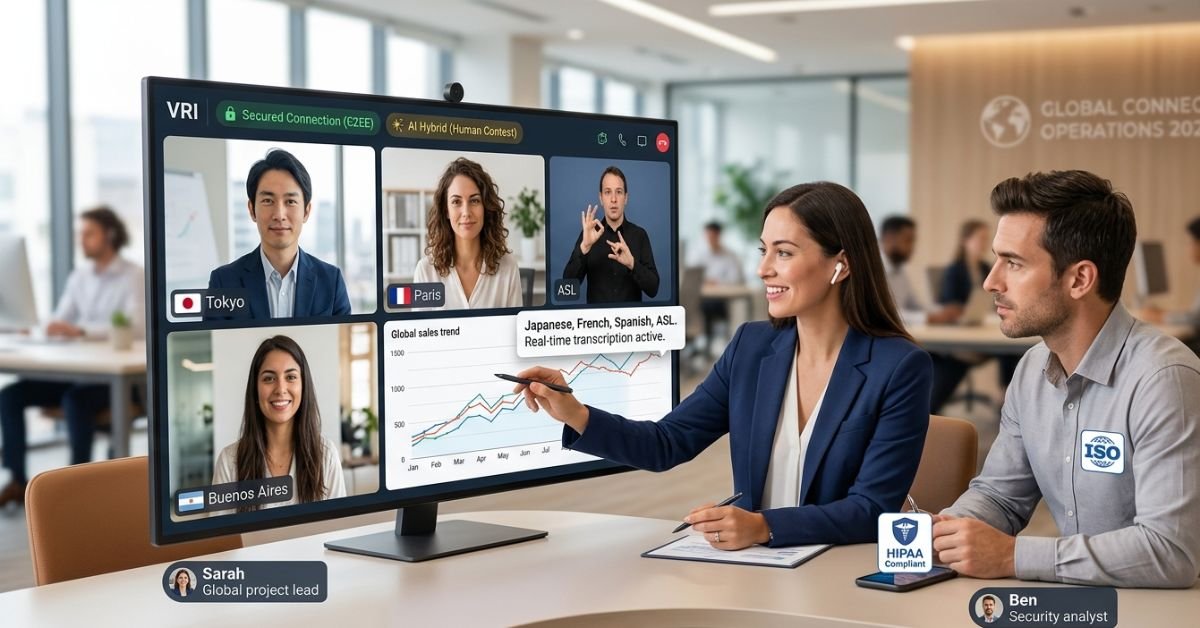
Video Remote Interpreting, often known as VRI, is becoming one of the most effective tools for companies that need fast, accurate, and human language support without waiting for an interpreter to arrive in person. It combines the speed of remote access with the visual connection of face-to-face communication, making it especially valuable for business meetings, customer support, HR conversations, training sessions, and international negotiations.
The Shift Toward Multilingual Business Communication
The global workplace has changed quickly. Remote work, hybrid meetings, online sales, and international hiring have made multilingual communication part of daily operations. A company may have a customer in Miami, a supplier in Mexico, a developer in Brazil, and an investor in Europe, all involved in the same project.
In these situations, relying on informal language support can create confusion. Bilingual employees may help in casual conversations, but they are not always trained to interpret complex business discussions accurately. VRI gives companies access to professional interpreters who can join conversations quickly and help everyone participate with clarity.
Why VRI Fits the Speed of Modern Business
Business decisions often happen fast. A client needs assistance immediately. A meeting changes direction. A negotiation requires clarification. Waiting days to schedule an in-person interpreter is not always realistic.
VRI solves this problem by making interpretation available through video platforms. It allows companies to bring language support into a conversation when it is needed, without delaying operations. This speed is one of the main reasons businesses are adopting VRI as part of their communication strategy for 2026.
The Value of Seeing the Conversation
Unlike phone interpretation, VRI allows interpreters and participants to see each other. This matters because business communication is not only verbal. Facial expressions, gestures, tone, and reactions all influence meaning.
In a negotiation, hesitation can signal uncertainty. In an HR meeting, body language can reveal discomfort. In a customer service situation, visual connection can build trust. VRI helps interpreters capture these nonverbal cues and deliver a more accurate interpretation than audio alone.
How VRI Supports Customer Experience
Customer experience is a major business priority. Companies that serve multilingual audiences need to make sure customers feel understood, respected, and supported. Language barriers can damage trust quickly, especially when a customer is dealing with a problem or request.
VRI allows businesses to provide more personal language support than text translation or phone calls alone. The visual element makes communication feel more human. Customers can see that someone is present, listening, and helping them understand the conversation in real time.
VRI in Human Resources and Internal Communication
As companies hire more globally, HR teams face new communication challenges. Interviews, onboarding, training, workplace policies, performance reviews, and conflict resolution may involve employees who prefer different languages.
VRI can help HR teams communicate clearly while maintaining professionalism and confidentiality. This is especially important in sensitive conversations where employees need to fully understand their roles and expectations.
Why AI Alone Is Not Enough
Artificial intelligence translation tools are improving, but business communication often requires judgment. AI can translate words quickly, but it may miss intent, tone, or cultural context. In business, those details can change outcomes.
A professional interpreter can recognize when clarification is needed and ensure that communication remains accurate. In 2026, the most effective strategies will combine technology with human expertise.
The Business Case for VRI
VRI can reduce travel costs, improve response times, and make language support more scalable. Instead of coordinating in-person interpreter schedules for every meeting, businesses can access interpreters remotely when needed. This flexibility is especially useful for companies with international operations.
It also helps prevent misunderstandings that could lead to lost opportunities or internal confusion. Clear communication protects both revenue and relationships.
What Businesses Should Expect in 2026
In 2026, VRI is expected to become more integrated into everyday business platforms. Companies will likely use it within video meetings, customer service systems, and internal workflows. Faster connectivity and improved tools will make VRI even more accessible.
At the same time, expectations will rise. Businesses will look for interpreters with professional training and industry knowledge to ensure consistent communication quality.
A New Standard for Global Business
Video Remote Interpreting is becoming essential because business is more multilingual and more connected than ever. Companies that invest in clear communication will be better positioned to grow, collaborate, and compete globally.
In 2026, VRI will not be just a convenience. It will be part of how global business operates.
