
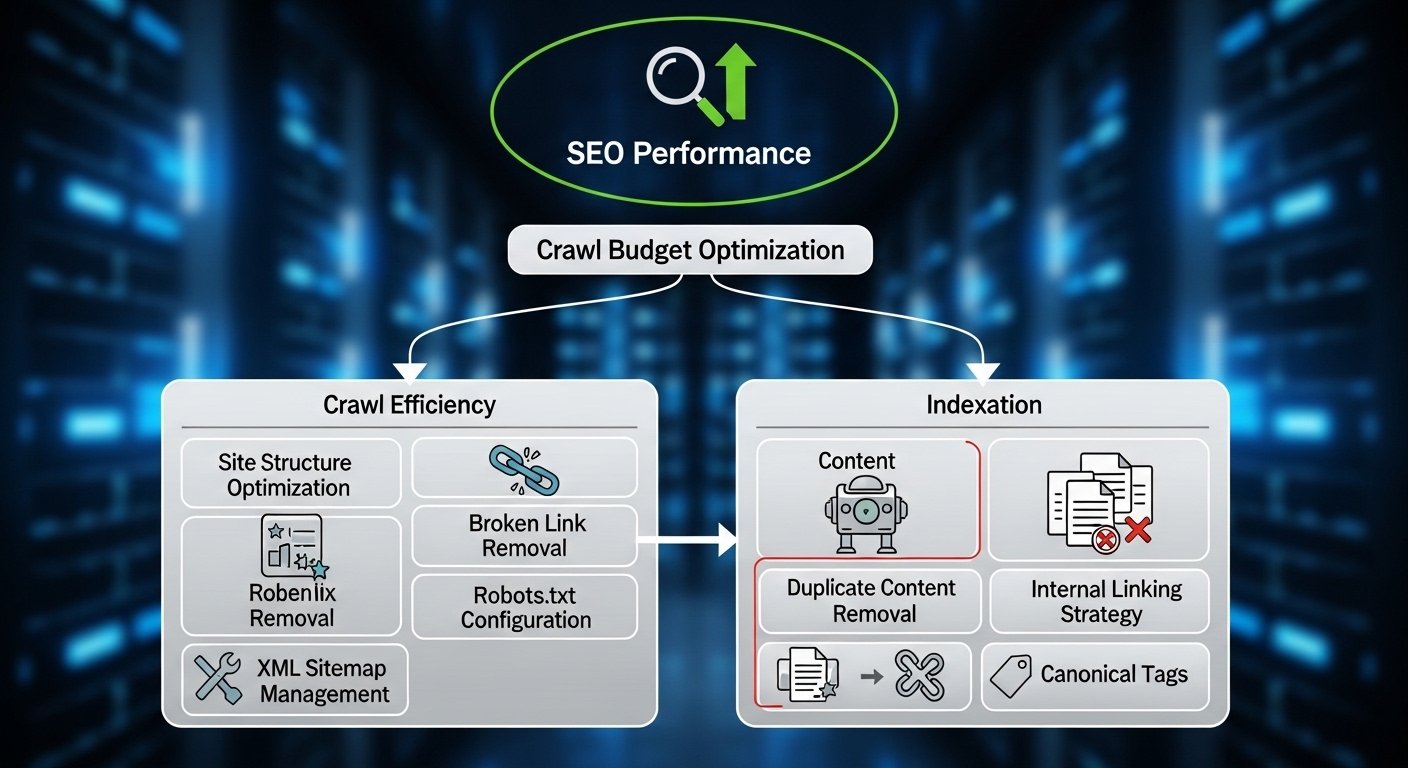
Crawl Budget Optimisation for Large Websites

As websites grow in size and complexity, managing how search engines crawl them becomes increasingly important. For large websites with thousands—or even millions—of URLs, crawl budget optimisation is a critical SEO consideration. Without a clear strategy, search engines may waste crawl resources on low-value pages while missing important content altogether.
Crawl Budget Optimisation helps ensure that search engine bots focus their limited crawling capacity on pages that matter most. For businesses investing in SEO, especially those operating at scale, understanding crawl budget and how to manage it effectively is essential for long-term search visibility.
What Is Crawl Budget?
Crawl budget refers to the number of URLs a search engine crawler is willing and able to crawl on a website within a given time frame. While small websites rarely encounter crawl budget limitations, large websites often do—making crawl budget a practical constraint rather than a theoretical one.
Crawl budget is influenced by two primary factors:
- Crawl rate limit: How many requests a crawler can make without overloading the server
- Crawl demand: How much interest search engines have in crawling a site’s pages
Search engines aim to crawl efficiently, prioritising pages that are important, frequently updated, and well-linked internally.
Why Crawl Budget Optimisation Matters for Large Websites
For large websites, inefficient crawling can lead to serious SEO issues, including:
- Important pages not being crawled or indexed
- Delayed indexing of new or updated content
- Excessive crawling of low-value or duplicate URLs
- Wasted server resources
Crawl Budget Optimisation ensures that search engines spend their time crawling pages that contribute to organic performance rather than pages that dilute SEO value.
How Crawl Budget Affects SEO Performance
Crawl budget has a direct impact on SEO because crawling is the first step before indexing and ranking. Pages that are not crawled cannot be indexed, and pages that are not indexed cannot appear in search results.
Effective Crawl Budget Optimisation supports SEO by:
- Improving indexation of high-value pages
- Reducing crawl waste caused by duplicates and parameter URLs
- Accelerating discovery of new content
- Strengthening overall site quality signals
For enterprise-level sites, crawl efficiency can influence how quickly SEO improvements are reflected in search performance.
Common Crawl Budget Challenges on Large Websites
Large websites often face crawl inefficiencies due to structural and technical issues.
Duplicate and Near-Duplicate Pages
URL parameters, filters, session IDs, and faceted navigation can generate thousands of duplicate URLs, consuming crawl budget unnecessarily.
Thin or Low-Value Content
Pages with minimal or repetitive content offer little SEO value but can still attract crawler attention if left unmanaged.
Poor Internal Linking
Orphan pages and deep page structures make it harder for crawlers to discover and prioritise important content.
Slow Server Response
Slow page load times reduce crawl capacity, limiting how many URLs search engines can crawl during a session.
Crawl Budget Optimisation Strategies for Large Websites
1. Prioritise High-Value Pages
Not all pages deserve equal crawl attention. Crawl Budget Optimisation begins with identifying which pages contribute most to SEO goals.
High-priority pages typically include:
- Core service or category pages
- High-performing landing pages
- Frequently updated content
- Pages with strong internal or external links
These pages should be easy to reach through internal links and free from crawl barriers.
2. Improve Internal Linking Structure
Internal linking plays a central role in Crawl Budget Optimisation. Well-linked pages are crawled more frequently and treated as more important.
Best practices include:
- Linking to priority pages from high-authority pages
- Reducing click depth across the site
- Using contextual, descriptive anchor text
- Eliminating orphan pages
A logical internal linking structure helps search engines navigate large websites efficiently.
3. Control Duplicate URLs and Parameters
Managing duplicate content is one of the most impactful crawl budget strategies.
Key actions include:
- Using canonical tags correctly
- Blocking unnecessary URL parameters via robots.txt or Search Console
- Consolidating similar pages
- Avoiding indexation of filtered or faceted URLs where possible
Reducing duplication ensures that crawl budget is focused on unique, index-worthy content.
4. Optimise Robots.txt Strategically
Robots.txt allows site owners to guide crawlers away from low-value sections of a website.
For large websites, robots.txt can be used to:
- Block crawl paths that generate infinite URLs
- Prevent crawling of admin, staging, or utility pages
- Reduce crawl waste without affecting indexation of important pages
Careful configuration is essential to avoid accidentally blocking valuable content.
5. Improve Page Speed and Server Performance
Server performance directly affects crawl rate limits. Slow response times can reduce how many pages search engines are willing to crawl.
To improve crawl efficiency:
- Optimise server response times
- Use caching and compression
- Reduce unnecessary redirects
- Fix server errors (5xx responses)
Faster websites enable crawlers to process more URLs within the available crawl budget.
6. Maintain Clean XML Sitemaps
XML sitemaps help search engines understand which pages should be crawled and indexed.
Effective sitemap practices include:
- Including only canonical, indexable URLs
- Removing redirected or noindexed pages
- Segmenting large sitemaps by content type
- Updating sitemaps regularly
Sitemaps should support crawl prioritisation, not replace internal linking.
Monitoring Crawl Budget Performance
Ongoing monitoring is essential for Crawl Budget Optimisation.
Key tools and data sources include:
- Google Search Console crawl stats
- Server log analysis
- Index coverage reports
- SEO crawling tools
These insights help identify crawl inefficiencies, unexpected spikes in crawl activity, and pages consuming disproportionate crawl resources.
Crawl Budget Optimisation as an Ongoing SEO Process
Crawl Budget Optimisation is not a one-time task. As websites grow, add content, and evolve structurally, crawl behaviour changes.
Large websites should:
- Audit crawl behaviour regularly
- Reassess crawl priorities after major site changes
- Align technical SEO, content strategy, and internal linking
- Treat crawl efficiency as part of long-term SEO governance
A proactive approach prevents crawl issues from undermining organic performance over time.
Conclusion
Crawl Budget Optimisation is a foundational SEO practice for large websites that want to maximise visibility without wasting crawl resources. By prioritising high-value pages, controlling duplication, improving internal linking, and maintaining strong technical performance, businesses can ensure search engines crawl what truly matters.
For organisations operating at scale, especially in competitive digital environments, crawl budget should be managed with the same strategic focus as content and link building. When done correctly, it supports faster indexation, stronger rankings, and more efficient SEO outcomes.Looking to improve crawl efficiency and strengthen your SEO foundation at scale? Work with an experienced advertising ad agency in Singapore that understands how Crawl Budget Optimisation supports sustainable search growth. Take control of your crawl strategy today.
